Save 40% plus free shipping during our Summer Sale! Browse books.

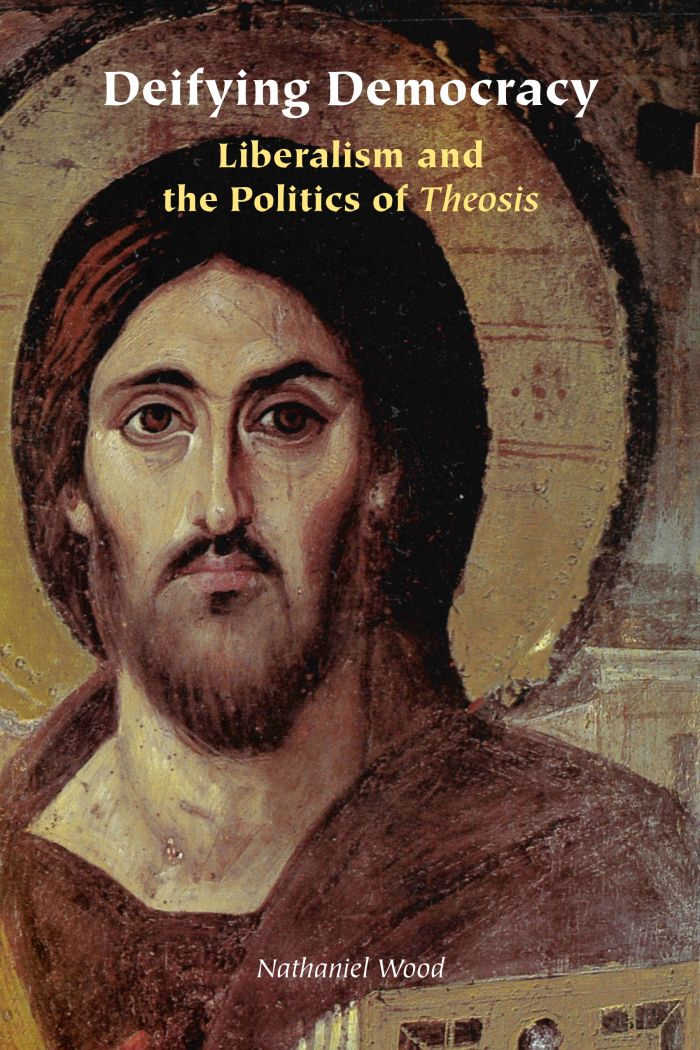
Deifying Democracy
Liberalism and the Politics of Theosis

This book can be opened with

An Orthodox Christian theological defense of liberal democracy that builds on the daring Christian humanist reinterpretation of incarnation and deification (theosis) in the Russian religious philosophy of Divine-Humanity
At a time when Christianity is becoming increasingly associated with anti-liberal and authoritarian sentiment, Deifying Democracy offers a theological defense of liberal democracy grounded in the Orthodox Christian doctrine of deification (theosis). Building on the participatory metaphysics of “Divine Humanity” in the modern Russian theologians Vladimir Soloviev, Sergei Bulgakov, and S. L. Frank, the book challenges the widespread view—perpetuated by prominent Orthodox voices, including Patriarch Kirill of Moscow—that deification is fundamentally incompatible with liberal democracy and universal human rights. The book particularly responds to the liberalism critique of John Milbank, who enlists modern Russian theology and its understanding of deification in support of an alternative “postliberal” Christian political order. The book develops a “politics of theosis” that grounds a form of liberal democracy within the ongoing story of God’s incarnation and humanity’s deification. By recovering a theological foundation for human dignity and democratic participation in human persons’ vocation to become “partakers of the divine nature” through free and creative cooperation with God’s deifying grace, the work offers an alternative to both secular liberalism and religious anti-liberalism.
The central argument proposes a “double movement,” modeled on the Chalcedonian confession of Christ’s divine-human unity, of supporting liberal democracy while working from within to transform it according to the principles of Christian love embodied in the Russian doctrine of sobornost’, or ecclesial communion. Rather than replacing liberal democracy with a Christian political order, the book advocates the work of “deifying democracy”—building up the liberal democratic institutions that facilitate human deification while seeking to incarnate sobornost’ in society through loving democratic dialogue about common goods.
The book will be of interest to readers hoping to understand how theosis, a central motif of Orthodox theology, can redeem and enrich rather than undermine liberal democratic values and institutions, as well as how liberal democracy is a system capable of serving the world’s deification.