Save 40% plus free shipping during our Summer Sale! Browse books.

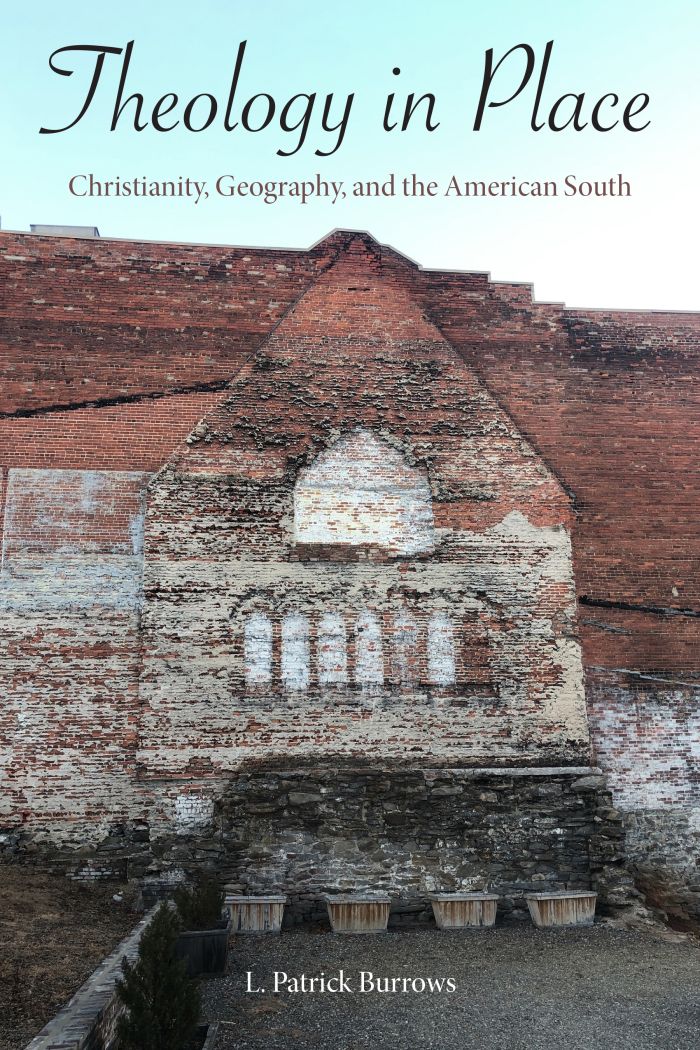
Theology in Place
Christianity, Geography, and the American South

This book can be opened with

A pathbreaking study of the role space and place play in theological thought
What does Christian theology have to do with place? How does theology influence the spaces and places in which we live? How does theology do geography?
In Theology in Place, L. Patrick Burrows develops a framework for the interpretation of the Christian theologies that form and are formed by human practices of place, drawing on theology, geography, and feminist, queer, and critical race studies for the analysis of places, from the perspectives of experience, moral geography, and “weak” theology. He then uses this method to take up a series of case studies of lived spaces of Southern religion to show the importance of thinking place in theology: the centrality of bodily communion between living and dead in Decoration Day in the Southern Appalachians; postcolonial “demonic” theology as the basis of spatial-spiritual ability surrounding the urban “renewed” Black neighborhood of Hayti in Durham, North Carolina; the role of heresiology in the construction of the historical and contemporary “imagined South” as the moral ubi of American social reflection; and the relationship between artifice, camp, and mysticism in the complex religious attachments—queer and evangelical—at Dollywood.
Theology in Place shows the necessity and promise of taking place seriously in the study of Christian theology, ethics, and practice. This research contributes to a growing literature on theology, space, place, and the built environment through its focus on race and the American South, especially by drawing on sources that have not previously been a part of these discussions, particularly from feminist, queer, and Black studies.