Save 40% plus free shipping during our Summer Sale! Browse books.

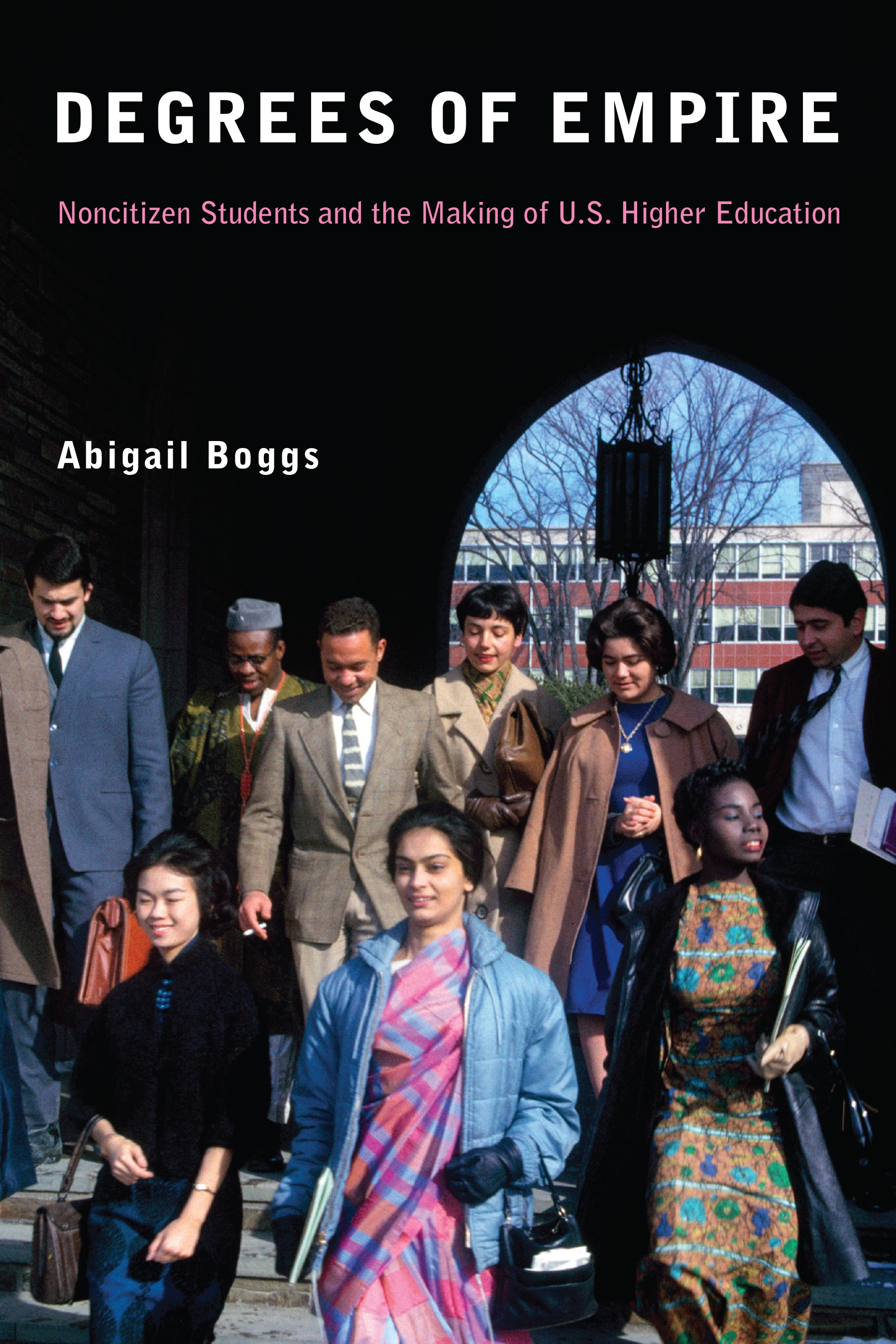
Degrees of Empire
Noncitizen Students and the Making of U.S. Higher Education

This book can be opened with

A sweeping history of how noncitizen students shaped U.S. universities
From colonial missionary schools to the globalized university of the twentieth century, U.S. higher education has long depended on students who were never meant to belong. Degrees of Empire tells the untold history of how noncitizen students—Indigenous youth, students from Asia, Africa, and the Caribbean, and others positioned outside the boundaries of citizenship—have been central to the making of American universities and the expansion of U.S. power.
Tracing the intertwined development of higher education, immigration law, and imperial governance from the seventeenth century through the mid-twentieth, Abigail Boggs shows how universities functioned as fundamental instruments of empire. Noncitizen students were recruited and educated under conditions of surveillance, restriction, and impermanence, trained to circulate knowledge, labor, and political ideals on behalf of the United States even as they were denied full political membership and exposed to constant threat of exclusion or deportation.
Drawing on archival records, immigration policy, institutional documents, and the writings of students themselves, Degrees of Empire demonstrates how universities helped produce racial hierarchies, manage populations, and naturalize liberal ideals of merit and mobility. By examining the figure of the noncitizen student genealogically across time, Boggs reveals a fundamental contradiction at the heart of U.S. higher education: Institutions that present themselves as open and universal have long relied on selective inclusion structured by race, citizenship, and capital.
At a moment when immigration and higher education are once again sites of intense political struggle, this book offers a powerful rethinking of the American university—not as a neutral engine of opportunity, but as a central technology of empire and a contested space in which alternative futures may yet be imagined.
Powerful, timely, erudite and rigorously researched, Degrees of Empire is incredibly prescient in this moment as the Trump regime targets international students for deportation. Readers of this book will come away with an understanding that such authoritarian orientations are inherent to the structure of international education. Indeed, Boggs gives us a framework for understanding the entire sweep of US empire.—Grace Kyungwon Hong, author of Death beyond Disavowal: The Impossible Politics of Difference
Abbie Boggs offers a profoundly structural but simultaneously humane account of the American university. In organizing her study around the figure of the noncitizen student, Boggs reveals how tensions and contradictions between university, state, capital, and empire evolve over time, shaping the very fabric of the institutions we inhabit.—Isaac Kamola, Professor of Political Science, Trinity College, Hartford