Save 40% plus free shipping during our Summer Sale! Browse books.

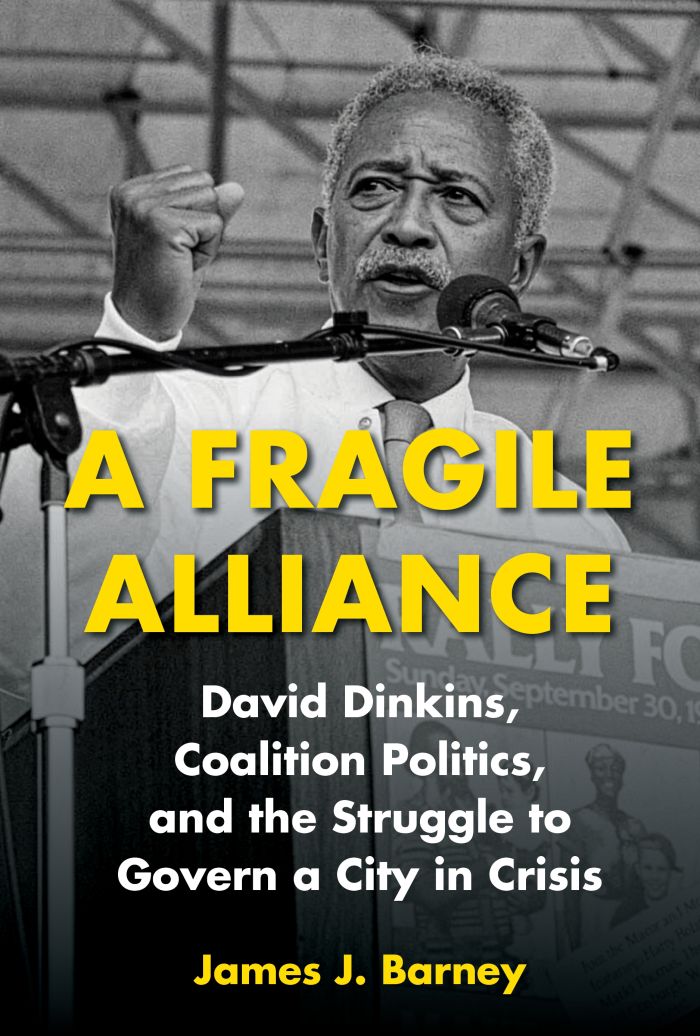
A Fragile Alliance
David Dinkins, Coalition Politics, and the Struggle to Govern a City in Crisis

This book can be opened with

A major reassessment of New York City’s first Black mayor and the fragile coalition politics that reshaped urban America
Charting the rise and fall of New York City’s first African American mayor, A Fragile Alliance offers a vivid, deeply researched account of governance, coalition-building, and political change in one of the nation’s most turbulent urban eras. Drawing on newly available archival sources, James J. Barney examines David Dinkins’s mayoralty (1989–1993) as both a turning point in New York City history and a revealing case study in the possibilities, and limits, of identity-based coalition politics.
Dinkins’s historic 1989 election brought together a diverse, multiracial alliance that defeated entrenched political power and promised a new vision for the city. Yet once in office, Dinkins confronted a cascade of crises: rising crime and the crack epidemic, racial tensions and the Crown Heights conflict, the AIDS epidemic and its activism, economic recession, and a growing conservative backlash. Barney shows how these flashpoints tested the fragile coalition that brought Dinkins to power and ultimately contributed to its unraveling.
Blending political history, urban studies, and biography, the book explores how race, class, gender, sexuality, and shifting party politics shaped both Dinkins’s governing challenges and the broader transformation of American liberalism in the late twentieth century. In reassessing a mayor often overshadowed by louder political figures, Barney illuminates how the Dinkins years anticipated today’s debates over policing, public safety, identity politics, and the future of Democratic coalition-building.
Written with narrative clarity and grounded in extensive archival research, A Fragile Alliance brings long-overdue attention to a pivotal moment in New York City’s political history and offers essential insight into the enduring complexities of governing a diverse metropolis in times of crisis.
James J. Barney’s Fragile Alliance: David Dinkins, Coalition Politics, and the Struggle to Govern a City in Crisis is a thoughtful and well measured examination of the first black mayor of New York City. Barney cautions political parties and political figures who embrace identity politics over issues that impact people across race, gender, class, and ethnicity. This book serves as a blueprint for those interested in a more long-lasting progressive agenda that can build broad coalitions, struggling for what the author asserts is a shared humanity. Barney’s call for a politics of love, instead of identity, is a bold and courageous solution, that few in academia and government would dare to utter.—Clarence Taylor, professor emeritus of History, Baruch College and the Graduate Center, CUNY, and author of Fight the Power: African Americans and the Long history of Police Brutality in New York City
David N. Dinkins became mayor with the support of a liberal coalition that proved impossible to maintain. James J. Barney reveals how Dinkins's effort to keep the city's 'beautiful mosaic' as a cohesive political movement was a mercurial, unpredictable, combustible endeavor, like trying to contain bolts of lightning in a metal box. That Dinkins suffered shocks and setbacks was less an indictment of his skills as a leader and more a revelation that the type of mid-century liberalism he championed had died. In its place was a new political and economic reality—neoliberalism—which made Dinkins's fragile political alliance impossible to sustain. This book tells the history of how the city we have today came out of the unfortunate demise of Dinkins's liberal dreams.—Brian Purnell, Associate Professor of Africana Studies and History, Bowdoin College, author of Fighting Jim Crow in the County of Kings: The Congress of Racial Equality in Brooklyn
With its penetrating and nuanced account of the Dinkins mayoralty in the twilight of liberalism, A Fragile Alliance makes a genuine contribution to the vast scholarship on New York City. It is required reading not only for students of New York City politics but also for those interested in the perils and possibilities of identity politics and the limits of urban liberalism.—Timothy Weaver, Associate Professor of Political Science at the University at Albany, SUNY
The definitive history of the David Dinkins era in New York City politics and a major contribution to the history of late 20th century American liberalism. Few studies of urban conflict and change possess A Fragile Alliance’s fairness, insight, depth, and humanity.—Jerald Podair, Professor of History, Lawrence University
A Fragile Alliance is a must-read for any student of late 20th century New York. James Barney deftly uses newly available archival sources and previously ignored community media to interrogate the caricature of Dinkins by the mainstream media. That carapace has been accepted without sufficient challenge for too long. It's a great read for both fans of NYC history and specialists, who will find new and sometimes surprising perspectives.—Jonathan Soffer, Professor Emeritus NYU and author of Ed Koch and the Rebuilding of New York
This important analysis describes the fracturing of the Democratic Party during Mayor Dinkins's single term in office. James J. Barney relies on newly available sources to reveal how race, class, sexuality, and ideological tensions reshaped the electoral landscape. A must read to understand New York City today.—Martha Biondi, author of To Stand and Fight: The Struggle for Civil Rights in Postwar New York City and The Black Revolution on Campus
James Barney’s A Fragile Alliance: David Dinkins, Coalition Politics, and the Struggle to Govern a City in Crisis is a deeply researched account of one of the most consequential moments in New York City’s political development. At its core, this is a tragic story: a decent mayor governing a city still reeling from fiscal crisis and battered by crack, AIDS, racial conflict, crime, and deep social fissures. In tracing how the tenuous coalition that elected Dinkins ultimately unraveled, A Fragile Alliance becomes more than an exceptional political study of New York City. It is also a sobering meditation on the limits of identity politics and the fragmentation of American liberalism itself. This is a timely, important, and must-read book.—Michael Javen Fortner, Pamela B. Gann Associate Professor of Government and George R. Roberts Fellow, Claremont McKenna College
Can Zohran Mamdani succeed where fellow DSA member David Dinkins struggled? This splendid study of New York City’s first Black mayor argues that, within America’s winner-take-all political system, progressive coalitions are more durable when they focus on universal programs of community welfare and safety rather than becoming consumed by the difficult and often divisive politics of identity. Barney makes a welcome contribution to the growing literature on how Democrats both advanced and stumbled during the neoliberal era.—Peter-Christian Aigner, Director, The Gotham Center for New York City History
A Fragile Alliance offers a vivid portrayal of the deep divisions in New York City during the mayoralty of David Dinkins, from Crown Heights to Staten Island. By showing the deep hostility that Mayor Dinkins confronted in much of the city, as well as the myriad conflicts he had with the very constituencies that brought him into elected office, A Fragile Alliance demonstrates the challenges that any progressive mayor faces in governing New York City.—Kim Phillips-Fein, Columbia University
Dedication | vii
Introduction: Dinkins, Coalition Politics, and the Future of Liberalism and the Democratic Party | 1
Part I: Flashpoints of Crisis and Coalition
1 The Belly of the Beast: Dinkins, Sharpton, and White Backlash | 15
2 Turf Battles and Media Narratives: The Boycott of the Family Red Apple Grocery Store | 41
3 Crown Heights: A Coalition in Crisis and a Test of Leadership | 62
Part II: Identity, Power, and the Limits of Identity-Based Governance
4 The Politics of Crack, Crime, and the “Ghettoization” of the Outer Boroughs | 85
5 Dinkins and White Women | 105
6 The Politics of HIV and Gay Rights | 121
7 “We Should Get Out Because New York Is Shot!”: The Staten Island Secession Movement | 147
Epilogue: The Fragility of Identity Politics | 174
Toward a Politics of Love: A Reading List | 183
Acknowledgments | 185
Notes | 187
Bibliography | 231
Index | 241
Photos follow page 120